
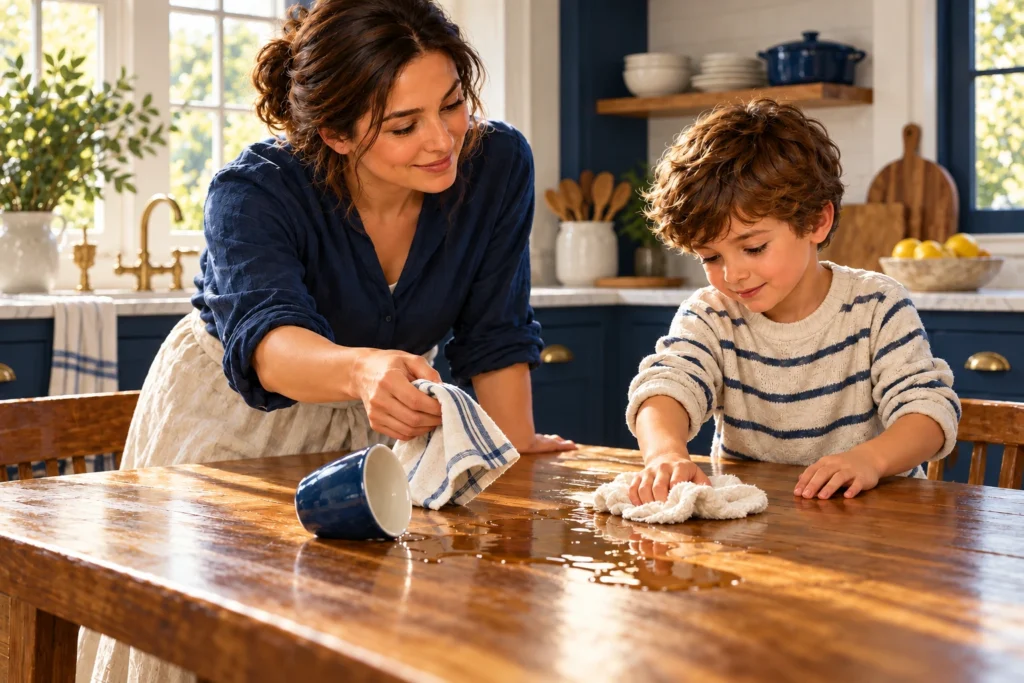
Your child lies, breaks something, or behaves unkindly. Before you have decided what to do, another thought arrives: “What does this say about me?”
That question can make a difficult moment heavier. Now you are responding to the behaviour and defending your identity as a parent at the same time.
A child’s mistake deserves attention. It does not provide a complete verdict on the person raising them.
Return to what actually happened
Separate the event from the story fear builds around it. “My child took something without asking” is an event you can address. “I have failed to raise an honest person” is a sweeping conclusion you cannot establish from that event alone.
Use the concrete account to decide your response. What was taken? Who was affected? What does the child understand? Is there immediate harm to stop? What repair is possible?
This approach does not minimize responsibility. It makes responsibility specific enough to act on.
In an illustrative situation, a child secretly eats food being saved for a visitor. The response might include returning what can be returned, helping prepare a replacement, and discussing asking permission. The useful lesson concerns honesty, consideration, and repair. A speech about how the child has embarrassed the entire family adds a burden without making that lesson clearer.
Address the behaviour without defining the child by it
UNICEF’s communication guidance encourages parents to focus on behaviour rather than labelling the child. “You took it without asking” leaves room for accountability and change. “You are selfish” turns the event into an identity.
The same distinction matters in how you speak to yourself. “I missed an opportunity to explain this rule” can guide a better conversation. “I am a terrible parent” does not identify what to do next.
Sometimes the behaviour reveals something adults need to change: unclear expectations, an inaccessible routine, a conflict we have ignored, or an example we have set. Examine those possibilities without assuming that every action has a single parental cause.
Children are developing people with their own decisions, relationships, temperaments, and circumstances. Parenting matters profoundly; it is not complete control over another human being.
Make room for repair
Once everyone is calm enough, ask the child to describe what happened. Explain the relevant boundary in language they can understand. Help them consider the effect on another person and an appropriate way to put things right.
A young child may need you to model the words. An older child may be able to propose a repair. In either case, avoid staging an apology purely for an audience. Understanding what needs repairing matters more than producing a perfect performance of remorse.
Consequences should be proportionate and connected to the situation where possible. Serious, repeated, or dangerous behaviour may require professional advice or safeguarding support. A general article cannot determine the right response to every family circumstance.
If you reacted harshly, your own repair can sit beside the child’s responsibility: “Taking that was wrong. Calling you names was wrong too. I am sorry for what I said, and we still need to put this right.”
Let the lesson be larger than the mistake
A home teaches more than whether people make errors. It also teaches what happens afterwards.
Can the truth be told? Can harm be named? Can someone accept a limit without being stripped of dignity? Can an adult reconsider a response?
Your child’s mistake may become a moment in which those questions receive an answer. You do not have to prove your entire worth as a parent before giving it.
Begin with the actual event. Hold the necessary boundary. Help with the next responsible action. That is substantial parenting work, even when it takes place on an untidy afternoon nobody would choose to photograph.
Sources and further reading
UNICEF: How to communicate effectively with your young child
Separate the actual incident from your judgment of yourself. What boundary and repair does this event need?
Explore all Insights Follow this reading path