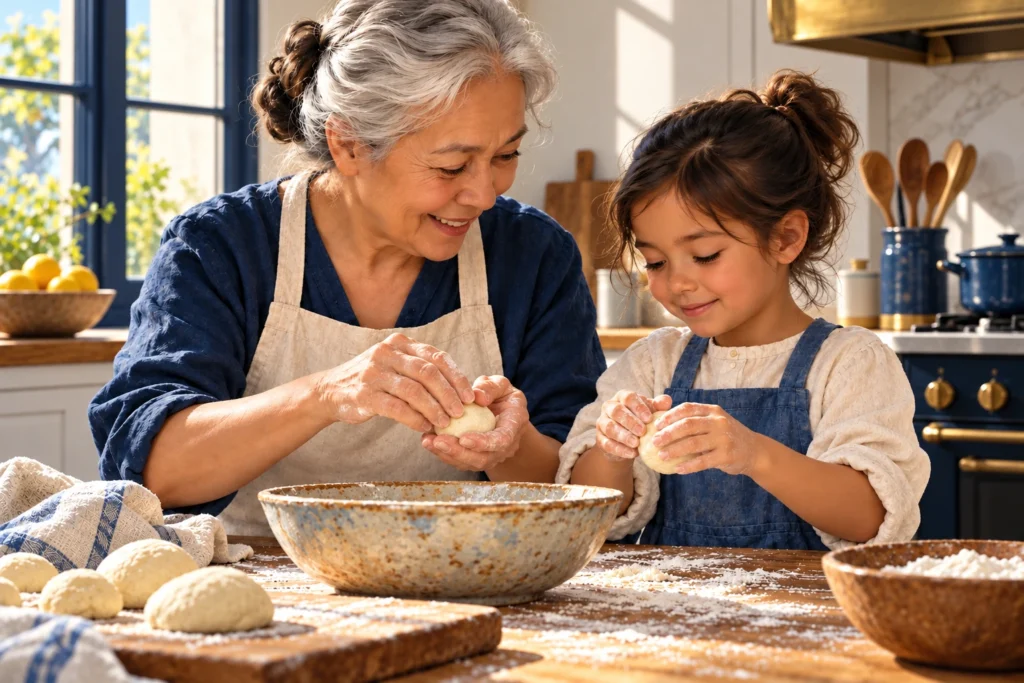
The recipe says, “Add enough flour.” Enough for what? The page does not explain. Someone who has made it for decades reaches for the bowl and shows you how the mixture should feel.
There is knowledge here that has never fitted neatly into instructions. There is also a voice, a gesture, and a memory of the kitchen where someone first learned it.
When a family moves across borders, a familiar dish can carry more than a taste. It can become a way to stay in conversation with a place, a person, or a version of home that is no longer close enough to visit easily.
Ask for the story beside the method
If someone in your family cooks a dish you want to preserve, ask more than how much salt they use. Who taught them? When was it served? Which part changed over time? What ingredient was difficult to find?
Let the answers complicate the idea of an original recipe. A dish may already have travelled through substitutions, marriages, shortages, new equipment, and personal preferences.
That history does not make it less meaningful. It shows people adapting the practice to the lives they actually had.
With permission, write down the method or make a recording. Include the details a standard recipe might omit: the thickness of a slice, the sound of a pan, the texture that means the dough is ready. Follow reliable food-safety guidance for the ingredients and preparation rather than treating family familiarity as a substitute for it.
Preserve the knowledge without demanding a performance
Someone may be happy to cook with you and uncomfortable being filmed. They may remember the method better while doing it than while answering a long list of questions.
Ask how they would like to share it. Keep the record private unless they agree to a wider audience. A family story is not automatically public material because it would make a beautiful post.
And leave room for an incomplete account. “I do not remember who taught me that part” is an honest piece of the history. Do not fill the gap with an invented origin because the story seems to need one.
Let the dish change countries without losing its relationship
An ingredient may be unavailable in a new home. The oven may behave differently. A family member may need an adaptation for an allergy or dietary requirement.
Instead of arguing immediately about whether the altered dish is authentic, ask what you are trying to preserve: a flavour, a technique, the act of preparing it together, or the memory of a person.
Different answers may lead to different choices. You can record the earlier version and the adaptation, including why it changed. A child can learn both the inherited method and the practical circumstances of the present household.
For someone unable to recover an old recipe, a new shared dish can still become meaningful. Belonging does not depend on possessing a perfect family archive.
Give the next generation something they can use
Invite children or younger relatives into a safe, age-appropriate part of the preparation. Let them notice, ask, and make a small contribution. Explain unfamiliar words without making their lack of knowledge a source of embarrassment.
Write a usable recipe as well as preserving the memories: ingredients, quantities where possible, sequence, and the signs that guide the cook. Test it yourself and mark what still needs clarification. “Grandmother just knew” is affectionate, but it may not help the person standing alone in a kitchen years later.
One day, that person may open the record in another city. They may hear a remembered instruction, adjust an ingredient, and invite someone new to the table.
The dish will not bring every lost place back. It may carry a relationship forward—through a practical act as ordinary as measuring flour, warming a pan, and making enough to share.
With permission, record one family recipe’s method and one story about how it changed.
Explore all Insights Follow this reading path